Rinse away cleaning residues before tea
A kettle can look clean while still needing the final fresh-water steps. Keep the cleaning and drinking stages clearly separate.
The last stage is part of the job
Descaling often gets treated as the main event, with rinsing reduced to a quick swirl under the tap. Yet the point of cleaning a kettle is to leave it ready for drinking water, not merely free of visible marks. Read the entire care sequence before you begin, including the fresh-water steps at the end. Some instructions require boiling and discarding fresh water after the cleaning solution has been removed. Follow the procedure for your model and cleaning product; do not substitute a guessed number of rinses. A clear interior is not proof that the required process is complete.
Keep the appliance unavailable for normal use until you have finished. In a shared kitchen, a short spoken reminder or a clearly placed note can prevent someone from switching it on midway through cleaning. Never use the cleaning solution for tea or sample it to judge whether it tastes normal.
Reach the areas the water touches
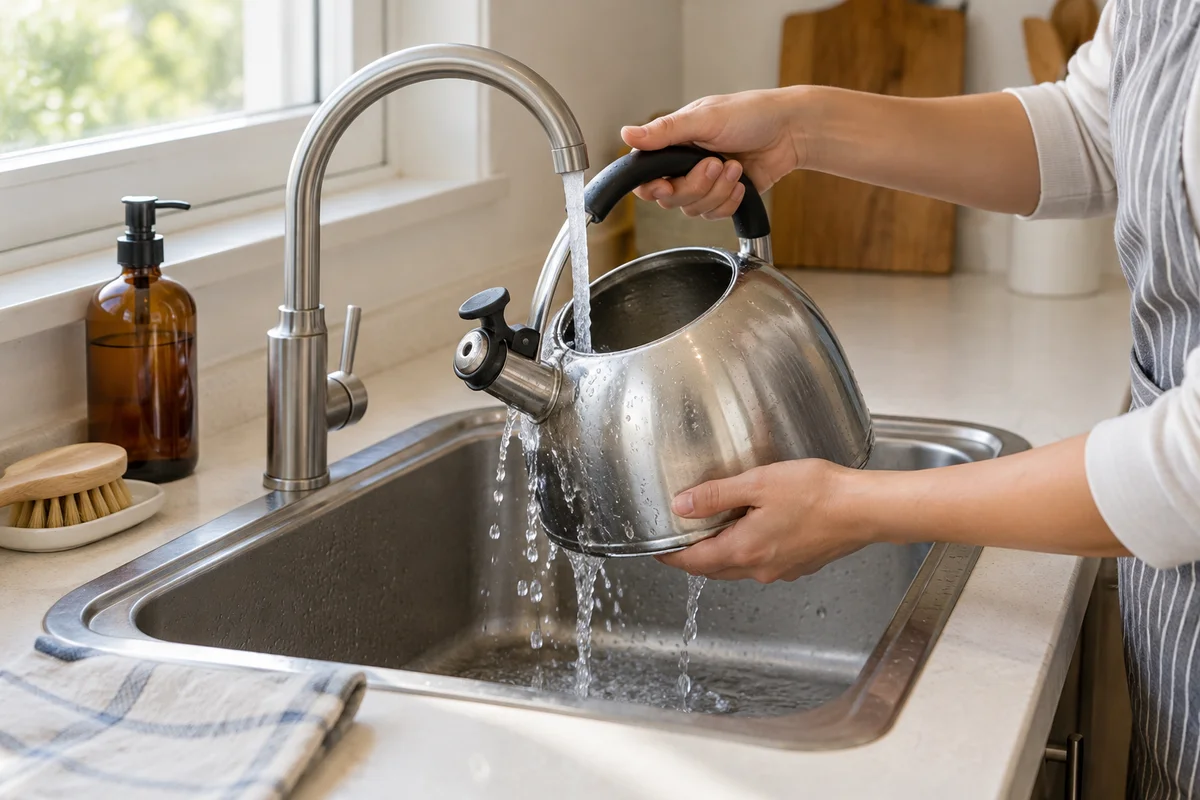
When the kettle is cool and disconnected as instructed, empty it carefully and rinse the permitted interior surfaces. Pay attention to the spout area and any removable filter mentioned in the manual. Do not immerse the electrical base or allow water into connections while trying to wash the outside. A detachable kettle body is not automatically an item that can be submerged. If you used a cloth or cleaning tool, make sure it has not left fibres or fragments behind. Refit removable pieces correctly after their own cleaning and drying steps.
Return to an ordinary cup without guesswork
Complete any boil-and-discard cycles using fresh water within the appliance's stated fill limits. Let hot water and the kettle cool enough for safe handling between steps, as the instructions require. If an unusual smell, residue or foaming remains after the specified process, stop and consult the product guidance or manufacturer rather than repeatedly tasting the water. Also consider whether a cleaning product was suitable in the first place. Once normal use can resume, the next cup should be about the tea again. Keeping the manual accessible and using one familiar, approved cleaning method makes this final stage easier to carry out consistently.